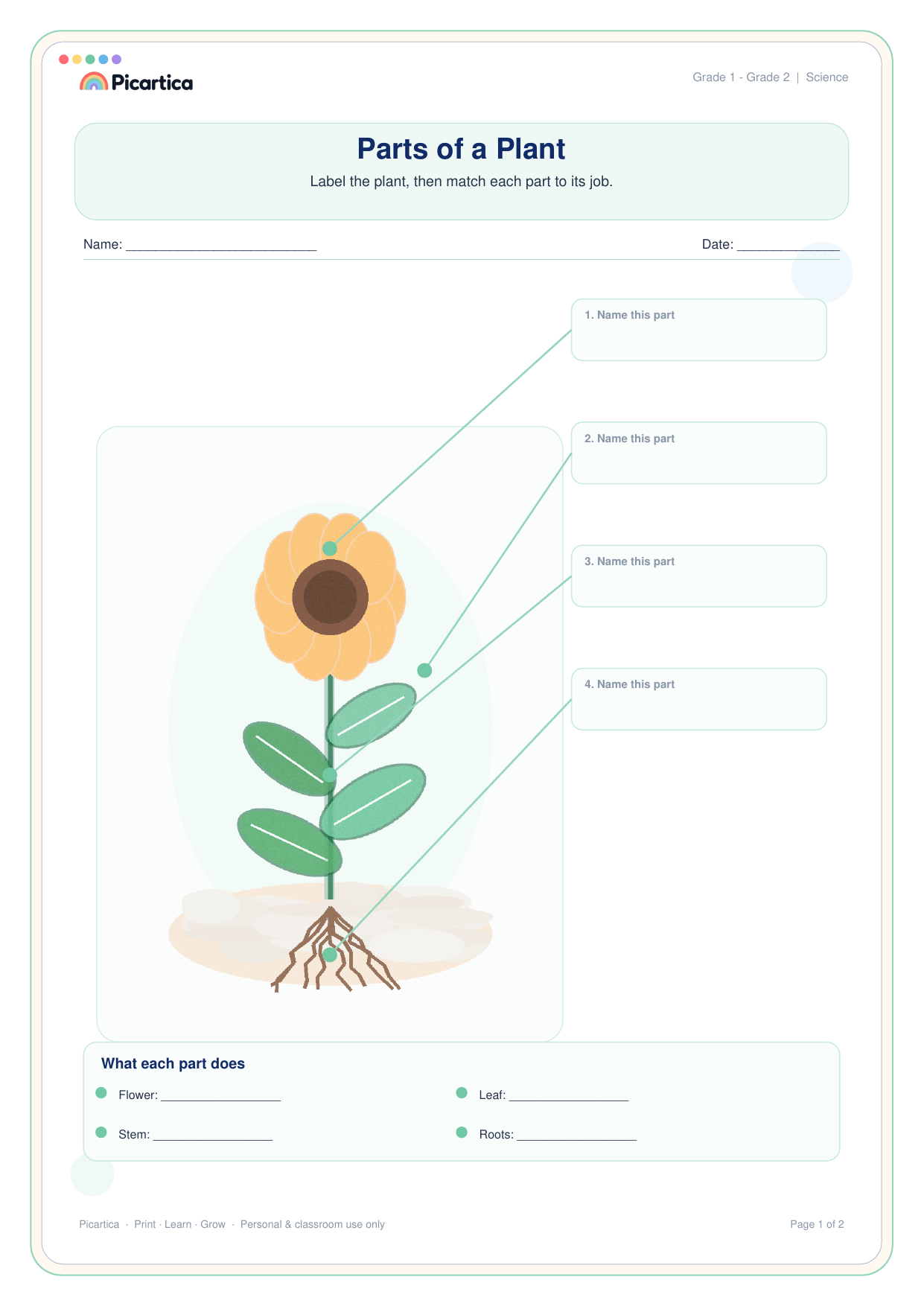
Parts of a Plant worksheet preview page 1
Preview · 1 / 1
Free

Parts of a Plant

This worksheet introduces the main visible parts of a flowering plant and asks children to identify or match structures such as roots, stem, leaves and flower. The aim is to connect words with features children can also observe in real plants, rather than treating plant vocabulary as a list to memorise.

GradeGrades 1–2 SubjectScience SkillPlant parts DifficultyDeveloping
Pages1
IncludesSingle-page printable activity
Print formatsA4 + US Letter
AccessFree worksheet

Free for personal, homeschool and classroom practice according to Picartica’s usage terms.

Educational overview

Early science begins with careful observation. Learning the names of plant parts gives children language for describing what they see and prepares them to discuss what different structures do. At this stage, the most useful understanding is concrete: roots are usually below the soil, the stem supports the plant, leaves grow from the stem, and flowers are one visible part of many flowering plants.
Learning objective

Build confidence in plant parts by practising identify common plant structures and match science vocabulary to a diagram.

What children will practise

  • Identify common plant structures
  • Match science vocabulary to a diagram
  • Notice where each plant part is located
  • Describe a plant using appropriate words

How to use this worksheet

Look at the plant diagram together before completing any labels. Ask your child what they notice first and let them point to each part before naming it. After completing the activity, compare the picture with a real plant, garden plant or photograph and look for the same structures.

Parent / Teacher tips

  • Ask the child to describe one feature they compared before choosing a match.
  • If an answer is incorrect, ask the child to explain the thinking first, then correct only the step that caused the error.

Common mistakes to watch for

  • Calling every green part a leaf, including the stem.
  • Assuming roots are absent because they cannot be seen above the soil.

Extension activity

Choose a real plant and make a simple observation drawing. Label any roots, stem, leaves and flowers that are visible. If the roots cannot be seen, add a dotted line to show where the soil would be.

What’s included

  • 1-page printable PDF
  • 1 plant-parts activity page
  • Single activity page
  • A4 and US Letter versions
TRY NEXT

Continue practising Plant parts

Use the subject and difficulty collections to choose the next appropriate practice.