Materials
Watercolor Paper Explained
Watercolor paper is not a passive background. Fibre, sizing, weight and surface all change how water moves, how pigment settles and how long a wash remains workable.
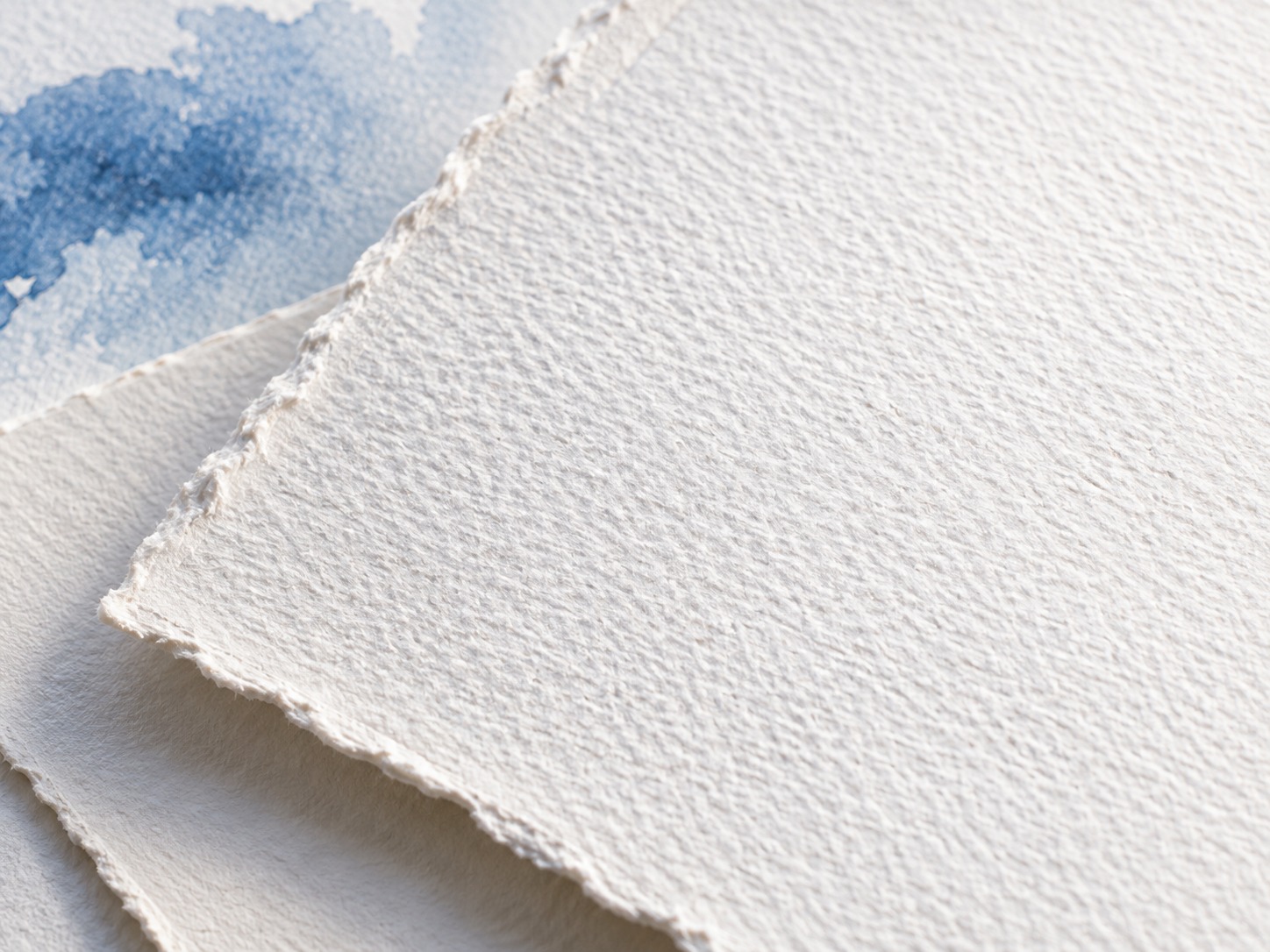
Read watercolor paper through four properties: fibre composition, sizing, grammage and surface. No single specification tells you whether a sheet is right for your technique.
Fibre composition
Watercolor paper is formed from plant fibres. Artist papers may use 100% cotton, wood-pulp cellulose, or blends of the two. Cotton is widely valued for strength and wet-working behaviour, but fibre composition alone does not determine the finished paper.
Two cotton papers can behave differently because their sizing, surface and manufacturing differ. The same is true of two cellulose papers.
What is sizing?
Sizing regulates how readily water penetrates the sheet. Without enough controlled resistance, watercolor can sink too quickly into the fibres; with more resistance, paint can remain workable near the surface for longer.
Manufacturers may use internal sizing, surface sizing, or both. The practical result is what matters most to the painter: how long the wash moves, how lifting behaves and how the surface tolerates repeated work.
What is gsm?
GSM means grams per square metre. It describes paper mass per unit area, not thickness. Heavier watercolor paper generally resists deformation from wet work better than lighter paper, but 300 gsm does not mean “will never buckle.”
Weight is one field in the material record—not a quality score.
Hot press, cold press and rough
| Surface | Typical character |
|---|---|
| Hot press | Smooth; useful for fine detail, line work and controlled shapes. |
| Cold press | Moderate texture; versatile across many watercolor techniques. |
| Rough | Pronounced texture; strong broken marks and visible pigment settlement. |
Surface names are categories rather than universal measurements. One manufacturer's cold press can be smoother than another's.
Blocks, pads and loose sheets
A pad attaches sheets along one edge. A block restrains the top sheet around most or all edges while you paint. Loose sheets give you maximum flexibility for custom sizes, stretching and mounting.
Format does not change the underlying paper specification, but it changes convenience and how strongly the sheet is restrained while wet.
A practical paper test
- Paint a flat wash.
- Make a dry-brush stroke.
- Lift a stripe from a dry swatch.
- Add a second glaze.
- Apply one controlled wet passage and observe deformation.
Do this whenever you try a new paper. The first finished painting on an unfamiliar sheet should not be the first time you discover how it behaves.
Fibre gives the sheet structure. Sizing controls absorption. Grammage contributes to wet stability. Surface changes the mark.
Sources & verification
Core technical claims in this article were checked against the sources below. Picartica test protocols, editorial judgments and recommendations remain clearly separate from manufacturer claims.
- Canson — Manufacturing secrets: Watercolor paperManufacturer education
Cotton-fibre characteristics, cylinder-mould construction and sizing limiting absorbency. - Canson — Selecting your watercolor paperManufacturer education
GSM definition, lighter-paper buckling, 300 gsm as a general compromise, paper textures and blocks. - ARCHES — Aquarelle paperManufacturer
100% cotton, gelatin sizing to the core, cold/hot/rough textures, weights, lifting and limited deformation. - Fabriano — Artistico watercolor paperManufacturer
100% cotton mould-made paper, 300/640 gsm, multiple surfaces and improved surface sizing.
Verification status: core technical claims checked against the cited sources. Page structure, internal links and publication markup were re-audited for this release on 6 September 2026.