Paint Behaviour
Granulating Watercolors Explained
Granulation is the visible texture created when pigment settles unevenly rather than forming a completely smooth wash. Paper surface and water can amplify the effect.
Granulating watercolor dries with visible pigment texture. It can be subtle or dramatic, and it is neither a defect nor a quality bonus—it is a behaviour you can choose when texture helps the painting.
What granulation looks like
Two blue washes can dry very differently. One may remain almost perfectly even. Another may show darker particle deposits, lighter gaps and a mottled surface that seems to reveal the physical grain of the paper.
That second behaviour is granulation.
Why some pigments granulate
Pigments are physical particles, and they do not all share the same particle characteristics. Some settle more uniformly; others gather into visible patterns as the wash moves and dries.
For artists, the exact microscopic mechanism is less useful than the observable question: does this specific paint create texture under the conditions I actually use?
Paper and water change the visible effect
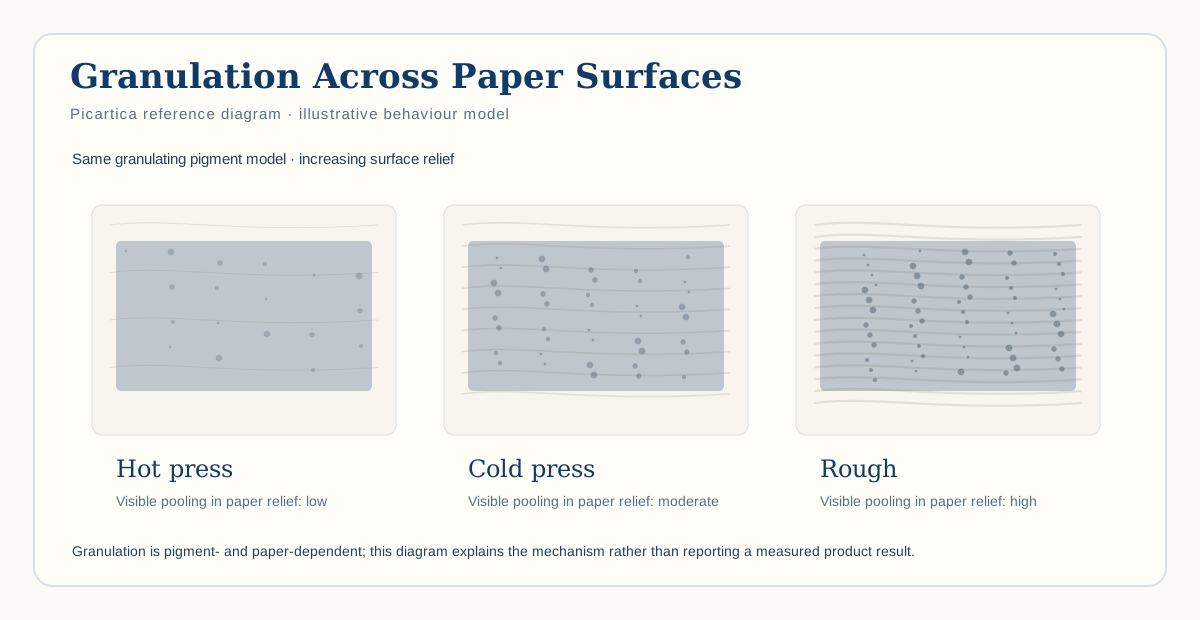
Rougher paper can make granulation more conspicuous because pigment settles through a more pronounced physical surface. More water can also give pigment additional opportunity to move and collect before the passage dries.
This is why a granulation swatch without the paper specification is incomplete.
Hot press, cold press and rough
The same granulating color may appear comparatively restrained on smooth paper and far more dramatic on rough. Picartica's eventual controlled test should show at least two standardized surfaces.
Granulation is not staining or opacity
| Granulation asks | Other property asks |
|---|---|
| How evenly does pigment settle? | Staining: how easily can it be lifted? |
| How visible is the pigment texture? | Transparency: how much can you see through it? |
A granulating color can be transparent or opaque, strongly staining or easy to lift.
When granulation helps
- Stone and mineral surfaces.
- Mountains and weathered forms.
- Clouds and atmosphere.
- Sand, soil and bark.
- Abstract texture where the material itself is part of the subject.
If you need perfectly smooth graphic color, a highly granulating pigment may make that job harder. Again, the behaviour is useful only in relation to intention.
How Picartica should test granulation
Use the same paint concentration and water protocol on standardized cold-press and rough papers. Photograph after complete drying without repeatedly disturbing the wash.
Suggested record
Paint name · pigment code · manufacturer granulation rating · cold-press swatch · rough-paper swatch · staining · transparency · test paper · test date.
Granulation is neither a bonus nor a defect. It is a material behaviour you can choose deliberately.
Sources & verification
Core technical claims in this article were checked against the sources below. Picartica test protocols, editorial judgments and recommendations remain clearly separate from manufacturer claims.
- DANIEL SMITH — Watercolor Pigment CharacteristicsManufacturer data
Per-colour lightfastness, staining, granulation, transparency and pigment-code fields. - DANIEL SMITH / Jane Blundell — Granulating Watercolors: What & WhyManufacturer education
Granulation as uneven particle settlement; rougher paper and more water increasing the visible effect. - Schmincke — HORADAM AquarellManufacturer
Same formulation for pans/tubes; granulating and supergranulating colour definitions; rough paper/water influence.
Verification status: core technical claims checked against the cited sources. Page structure, internal links and publication markup were re-audited for this release on 6 September 2026.