
Paint Behaviour
Staining vs Non-Staining Watercolors
Staining describes how difficult a watercolor is to lift after it has contacted the paper. It affects corrections, highlights, glazing and how stable earlier layers feel under later brushwork.
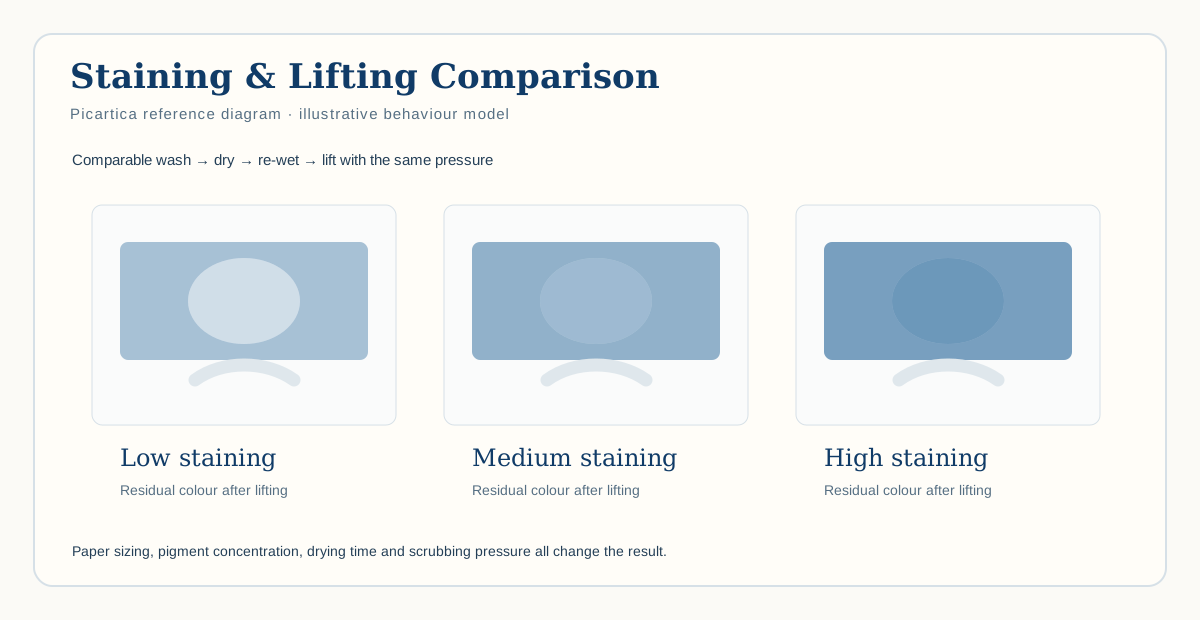
Low-staining colors tend to lift more readily. Strongly staining colors leave more color behind after rewetting. Staining is not the same thing as lightfastness, transparency or granulation.
What does staining mean?
Paint a wash, let it dry, then rewet part of it and lift with a clean brush. Some colors may become dramatically lighter. Others barely move. That difference is what artists describe as staining.
Manufacturers use different scales: one may say non-staining, low, medium and high staining; another may describe colors as easy, partial or difficult to lift. Picartica should preserve those native rating systems rather than silently converting them into false universal precision.
Why staining matters
Low-staining colors give you more opportunity to recover light, soften a dried passage or create lifted textures. Strongly staining colors can be useful when you want a layer to remain comparatively stable under later work.
The trade-off is straightforward: easy lifting creates flexibility; strong staining creates persistence.
Why paper changes the result
The pigment is only half the story. Paper fibre, sizing, surface and absorbency influence how deeply pigment and water interact with the sheet. A paint that lifts dramatically on one surface may behave differently on another.
Database rule
Every Picartica lifting swatch should identify the exact paper used. A staining claim without the surface is incomplete.
A simple staining test
- Paint an even swatch.
- Allow it to dry under a consistent protocol.
- Wet a clean stripe through the centre.
- Gently agitate with the same damp brush for the same number of passes.
- Blot if the test protocol calls for it.
The final card should show untouched wash, lifted stripe, untouched wash. Readers can then understand the behaviour visually rather than from a mysterious number.
Staining is not permanence
| Property | What it tells you |
|---|---|
| Staining | How difficult the dried color is to lift. |
| Lightfastness | Resistance to change under light exposure. |
| Transparency | How much the layer reveals what lies underneath. |
| Granulation | How unevenly pigment settles into visible texture. |
A transparent color can be highly staining. A granulating color can be easy to lift. These fields belong separately in the materials database.
How to use both behaviours
Low-staining colors can be wonderful for clouds, recovered highlights and soft atmospheric corrections. Strongly staining colors can be useful in layers where you do not expect to return to the white of the paper.
Staining tells you how reversible a dried watercolor passage is likely to be—not how good the paint is.
Sources & verification
Core technical claims in this article were checked against the sources below. Picartica test protocols, editorial judgments and recommendations remain clearly separate from manufacturer claims.
- DANIEL SMITH — Watercolor Pigment CharacteristicsManufacturer data
Per-colour lightfastness, staining, granulation, transparency and pigment-code fields. - ARCHES — Aquarelle paperManufacturer
100% cotton, gelatin sizing to the core, cold/hot/rough textures, weights, lifting and limited deformation.
Verification status: core technical claims checked against the cited sources. Page structure, internal links and publication markup were re-audited for this release on 6 September 2026.