Materials
Watercolor Brushes Explained
A watercolor brush is a liquid-delivery tool with a shape. Learn point, capacity, spring, stiffness and scale before worrying about prestige labels or fibre myths.
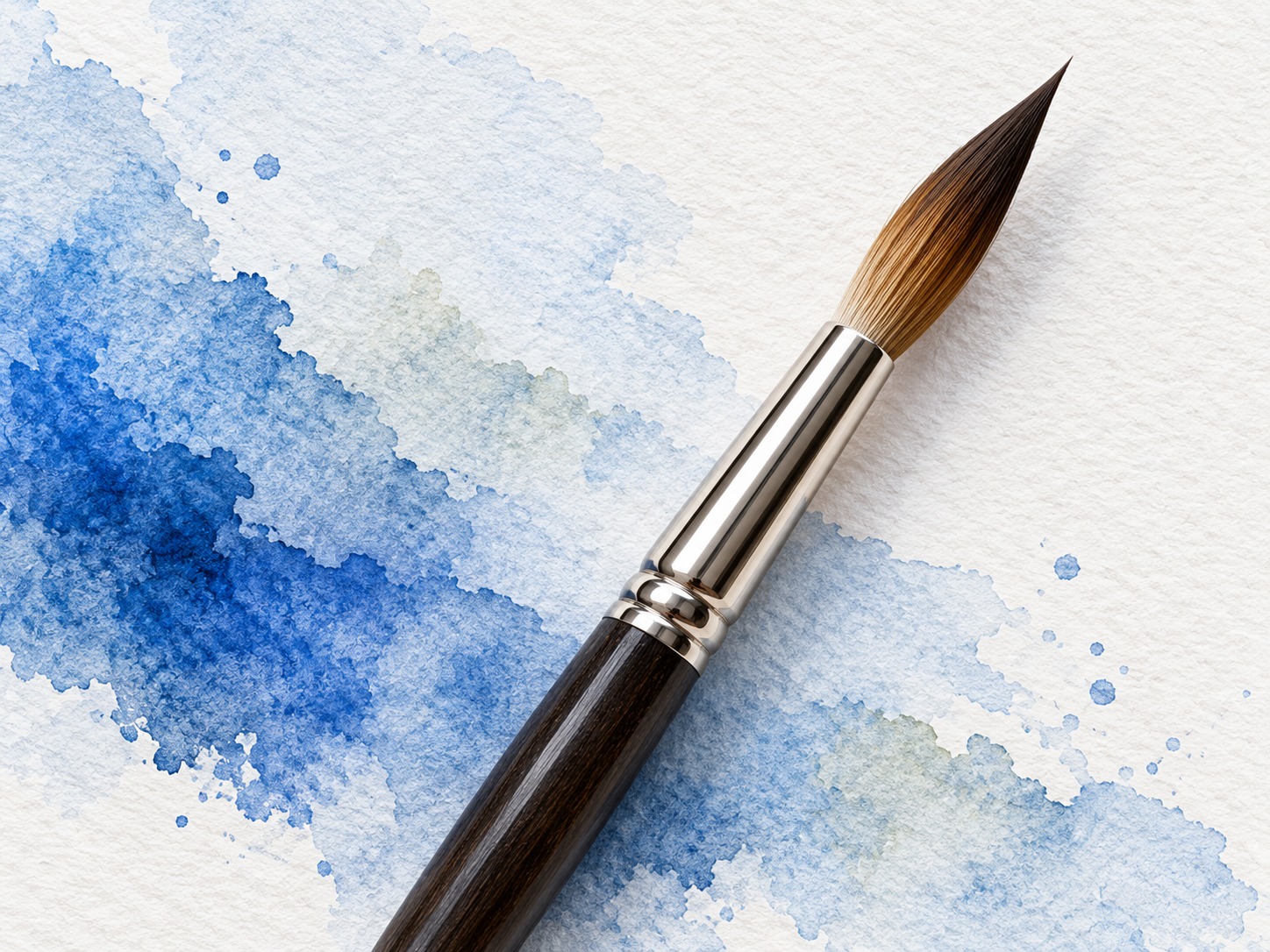
Judge watercolor brushes by what they need to do: form a point, carry enough liquid, respond to pressure, and match the scale of the painting. Fibre matters because it changes those behaviours—not because natural or synthetic is automatically superior.
The useful anatomy of a watercolor brush
Most brushes have a handle, ferrule and tuft. Within the tuft, the point controls fine placement and the fuller belly carries water and paint.
A well-designed round can move from a very fine line to a broad stroke because different parts of the same tuft contact the paper as pressure changes.
Point, capacity, spring and stiffness
| Characteristic | What it changes |
|---|---|
| Point | How precisely the brush places lines, corners and details. |
| Capacity | How much useful water and pigment it can carry. |
| Spring | How readily the tuft returns after bending. |
| Stiffness | How strongly the fibres resist pressure and disturb the surface. |
These are separate behaviours. A brush can have a fine point yet remain very soft; another can be springy but carry less water.
Natural vs synthetic
Modern synthetic watercolor brushes can be highly capable. Different synthetic filaments are engineered for different balances of softness, spring, point and capacity. Natural hairs also vary widely.
The useful buying question is not “which fibre is more professional?” but “does this brush carry enough liquid and make the marks I need?”
Brush size numbers are not universal
A size 8 from one manufacturer may have different tuft length, width, belly and capacity from a size 8 elsewhere. The printed number is most useful within one brush range.
Picartica should therefore record physical dimensions alongside manufacturer size numbers wherever possible.
How to test a watercolor brush
- Point test: make the finest controlled line you can.
- Pressure test: thin → broad → thin in one stroke.
- Capacity test: make one continuous stroke until the paint visibly exhausts.
- Recovery test: press the tuft and observe how it reforms.
- Dry-brush test: remove some moisture and drag across textured paper.
How to choose your first brushes
Start with one versatile medium round. Add a second brush only when it provides a capability the first lacks—perhaps a large wash brush, flat or rigger.
Buy the missing action, not the next item in a set.
Sources & verification
Core technical claims in this article were checked against the sources below. Picartica test protocols, editorial judgments and recommendations remain clearly separate from manufacturer claims.
- Winsor & Newton — Professional Watercolour Synthetic SableManufacturer
Synthetic brush colour-carrying capacity, spring and shape retention. - Winsor & Newton — Cotman Series 111 Round brushManufacturer
Round brush use for detail, lines, washes, broad strokes and forming a sharp point. - Escoda — Brush catalogueManufacturer catalogue
Independent absorption/stiffness ratings across fibres and multiple watercolour brush shapes.
Verification status: core technical claims checked against the cited sources. Page structure, internal links and publication markup were re-audited for this release on 6 September 2026.