Beginner Guide
Watercolor Supplies: What You Actually Need
A practical starter guide to paint, paper, brushes, palette and water—plus the materials you can safely postpone until your painting creates a reason to own them.
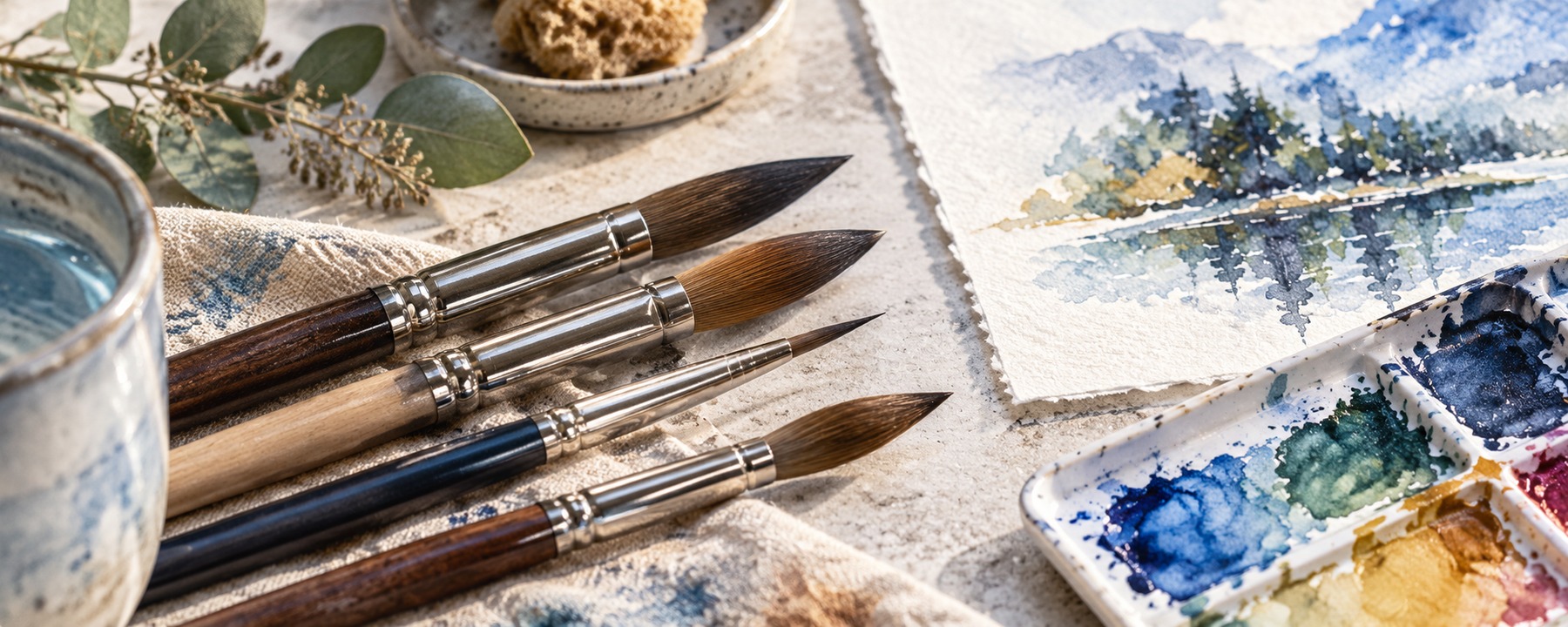
You can start watercolor with six things: a small paint palette, real watercolor paper, one versatile brush, a mixing surface, water and something absorbent. Everything else can be added when you know what capability is missing.
1. Watercolor paint
You do not need a 48-color set to learn watercolor. A smaller palette makes it easier to understand mixing, dilution and individual pigment behaviour. Roughly six to twelve useful colors are enough to learn an enormous amount.
Pans or tubes?
Pans are compact, convenient and easy to travel with. Tubes make it faster to release a larger quantity of strong paint for bigger washes. Neither format is automatically more professional.
Student or artist grade?
These labels describe different product ranges, not artistic rank. Ranges can differ in pigment choice, concentration, color selection, handling and price. A reputable student range can be entirely appropriate for learning, while a small professional palette can be a sensible choice for someone who wants exact pigment control.
2. Watercolor paper
If your budget forces you to prioritize one material, prioritize the paper. Poorly suited paper can make washes buckle, absorb unpredictably or become difficult to manipulate even when the paint and brush are fine.
Around 300 gsm is a practical starting weight for many beginners because it generally tolerates wet work more easily than lighter paper. Cold press is a sensible first surface because it gives some texture without pushing strongly toward the smooth or rough extreme.
Do not use gsm as a quality score
Weight, fibre, sizing and surface all matter. A 300 gsm sheet is not automatically superior to every 200 gsm sheet.
3. Watercolor brushes
You do not need ten brushes. A medium round can teach you point control, broad strokes, pressure changes and small washes. If you add a second brush, make it do something the first one cannot—perhaps a larger wash brush or a flat.
| What matters | Why |
|---|---|
| Point | Controls lines, corners and fine placement. |
| Capacity | Determines how much water and pigment the brush can carry. |
| Spring | Changes how quickly the tuft responds to pressure. |
| Shape | Makes some families of marks easier than others. |
Modern synthetic brushes can be extremely capable. Fibre type matters because it influences behaviour, not because one material automatically confers professional status.
4. Palette, water and cloth
A white non-absorbent surface is enough for mixing. A ceramic plate works. Two water containers are useful—one for the first dirty rinse and one for relatively clean water—but this is a convenience rather than a rule.
An absorbent cloth is one of the cheapest control tools you can own. It lets you remove water deliberately from the brush, which matters just as much as adding it.
What you do not need yet
- Dozens of brushes.
- Huge color sets.
- Masking fluid unless you need protected white shapes.
- Specialty watercolor mediums.
- Every exotic brush shape.
- Expensive storage systems.
Art materials are very good at creating the feeling that one more purchase will solve a painting problem. Often it will not.
Where should a beginner spend more?
- Paper: because the surface changes almost every technique.
- Paint: enough quality and strength to understand color and mixing.
- One versatile brush: not an entire premium collection.
Buy capabilities, not objects. Add a material when you can describe the problem it will solve.
Your first watercolor exercise
Before buying anything else, use what you have to make one page of tests: the thinnest and widest marks your brush can make, one pigment at four concentrations, the same pigment on dry/damp/wet paper, and two-color mixtures at several ratios.
That sheet will teach you more about your actual materials than another hour of shopping.
Sources & verification
Core technical claims in this article were checked against the sources below. Picartica test protocols, editorial judgments and recommendations remain clearly separate from manufacturer claims.
- Winsor & Newton — Cotman Watercolour Beginners BundleManufacturer
A practical beginner bundle combining pans, 300 gsm paper and brushes. - Canson — Selecting your watercolor paperManufacturer education
GSM definition, lighter-paper buckling, 300 gsm as a general compromise, paper textures and blocks. - Winsor & Newton — Cotman Series 111 Round brushManufacturer
Round brush use for detail, lines, washes, broad strokes and forming a sharp point.
Verification status: core technical claims checked against the cited sources. Page structure, internal links and publication markup were re-audited for this release on 6 September 2026.