
Comparison
Student Grade vs Artist Grade Watercolor
These labels describe product ranges, not artistic rank. Compare pigment choice, formulation, concentration, permanence and price instead of assuming that expensive automatically means right.
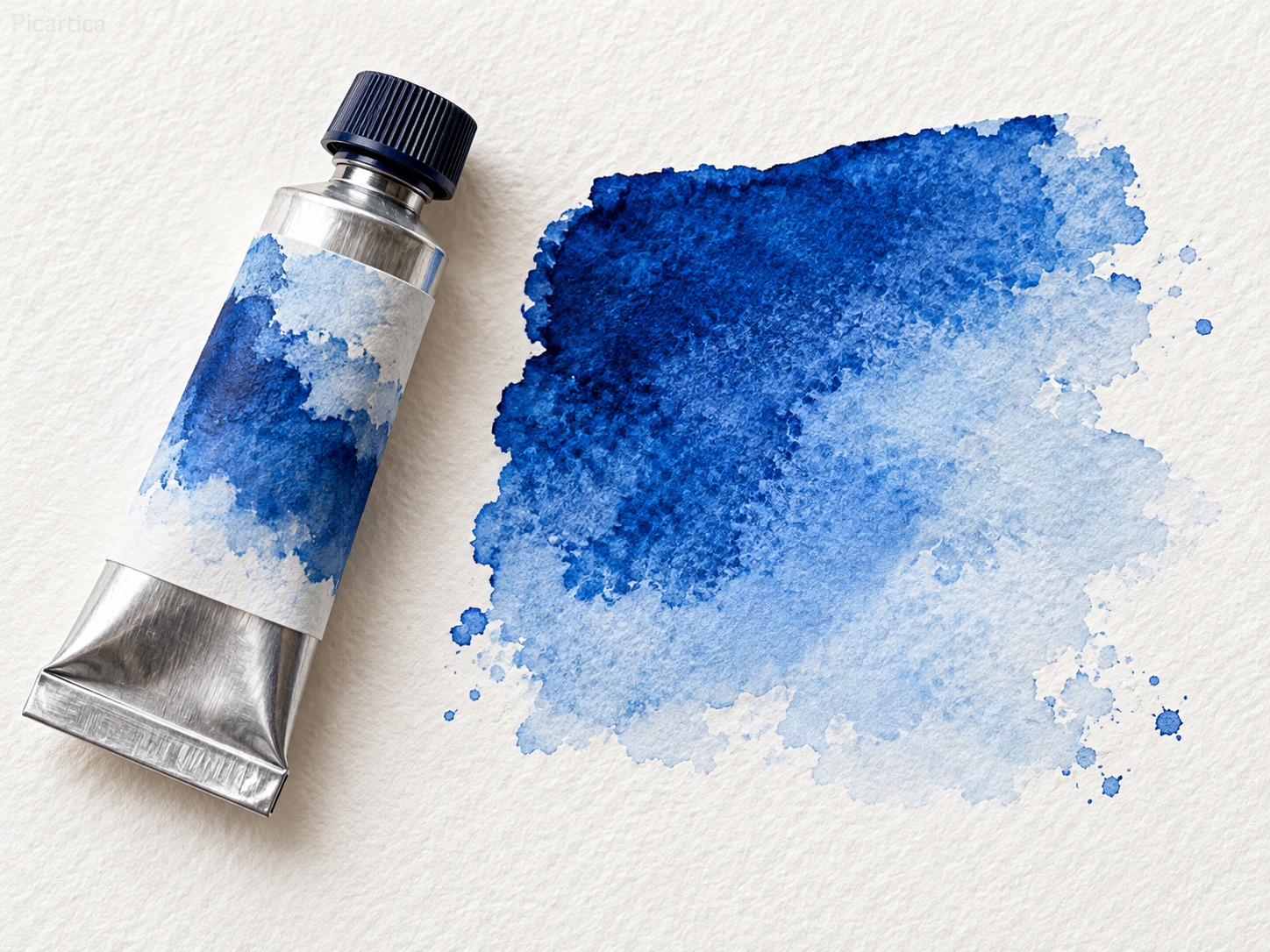
Artist-grade ranges often offer more pigment choice, more technical specificity and stronger concentration; student ranges usually reduce entry cost and simplify the range. Neither label tells you everything about an individual color.
What does “student grade” actually mean?
There is no single universal recipe called student-grade watercolor. Each manufacturer builds its accessible range differently. One company may reduce pigment concentration; another may simplify pigment selection, range size or manufacturing choices.
The safest interpretation is simply: a manufacturer's more accessible product range.
Pigment choice and concentration
Professional ranges often provide a wider selection of specific pigments and specialist behaviours. That matters once you care about the difference between several yellows, blues or earth colors that may look similar in a palette but behave differently in mixtures and layers.
Some student ranges use lower pigment load than their corresponding professional line. But pigment concentration is only one part of performance, and different pigments naturally have different tinting strength.
Single pigment vs mixtures
Single-pigment colors can make mixing easier to understand because you know exactly which colorant is entering the mixture. Multi-pigment colors are not inferior by definition; they can be intentionally formulated to create a useful hue.
Transparency and lightfastness are not grade labels
Professional watercolor can contain transparent, semi-transparent or opaque pigments because those are useful behaviours, not rankings. Likewise, individual student colors can have strong permanence ratings.
For finished work, look at the specific color's technical information. Do not assume that every paint in an expensive range is automatically more lightfast than every color in a student range.
| Characteristic | Student range | Professional range |
|---|---|---|
| Entry price | Usually lower | Usually higher |
| Range size | Often smaller | Often broader |
| Single-pigment options | May be fewer | Often more numerous |
| Specialist pigments | Less common | More common |
| Suitable for beginners | Yes | Yes |
| Automatically lightfast? | No | No |
What beginners may notice first
The most obvious differences are often paint pickup, concentration and how easily a strong mixture can be created. More subtle distinctions—staining, granulation, rewettability or the behaviour of a particular pigment in glazing—become more meaningful as technique develops.
Artist-grade paint cannot teach water control, composition or brush handling. Better-performing materials can remove obstacles, but they do not create skill by themselves.
A practical upgrade strategy
Start with a dependable set. Notice which colors you use constantly. Upgrade selectively when you can name the reason: you want a particular pigment, more strength, different granulation, better permanence or a formulation that solves a real problem.
Your palette does not have to belong entirely to one product line. Mixing grades is perfectly reasonable.
Compare before you upgrade
On the same paper, compare two similar colors from different ranges for pickup, strong wash, pale dilution, glazing, lifting and mixing. Ask whether the difference matters to your own work.
What Picartica means by quality
- Pigment information.
- Permanence.
- Transparency.
- Staining.
- Granulation.
- Tinting strength.
- Rewetting.
- Value for the intended use.
A professional label tells you where a manufacturer positions a range. The pigment information tells you what is actually in your paint.
Sources & verification
Core technical claims in this article were checked against the sources below. Picartica test protocols, editorial judgments and recommendations remain clearly separate from manufacturer claims.
- Winsor & Newton — Cotman Watercolour product informationManufacturer
Fine-art pigments; reduced pigment load versus Professional Watercolour; transparency/lightfastness positioning. - DANIEL SMITH — Watercolor Pigment CharacteristicsManufacturer data
Per-colour lightfastness, staining, granulation, transparency and pigment-code fields.
Verification status: core technical claims checked against the cited sources. Page structure, internal links and publication markup were re-audited for this release on 6 September 2026.