Technique
Wet-on-Dry Watercolor
Wet-on-dry puts wet paint onto a dry surface, giving the brush more control over where the mark begins and ends. It is the foundation of hard edges, defined shapes and glazing.
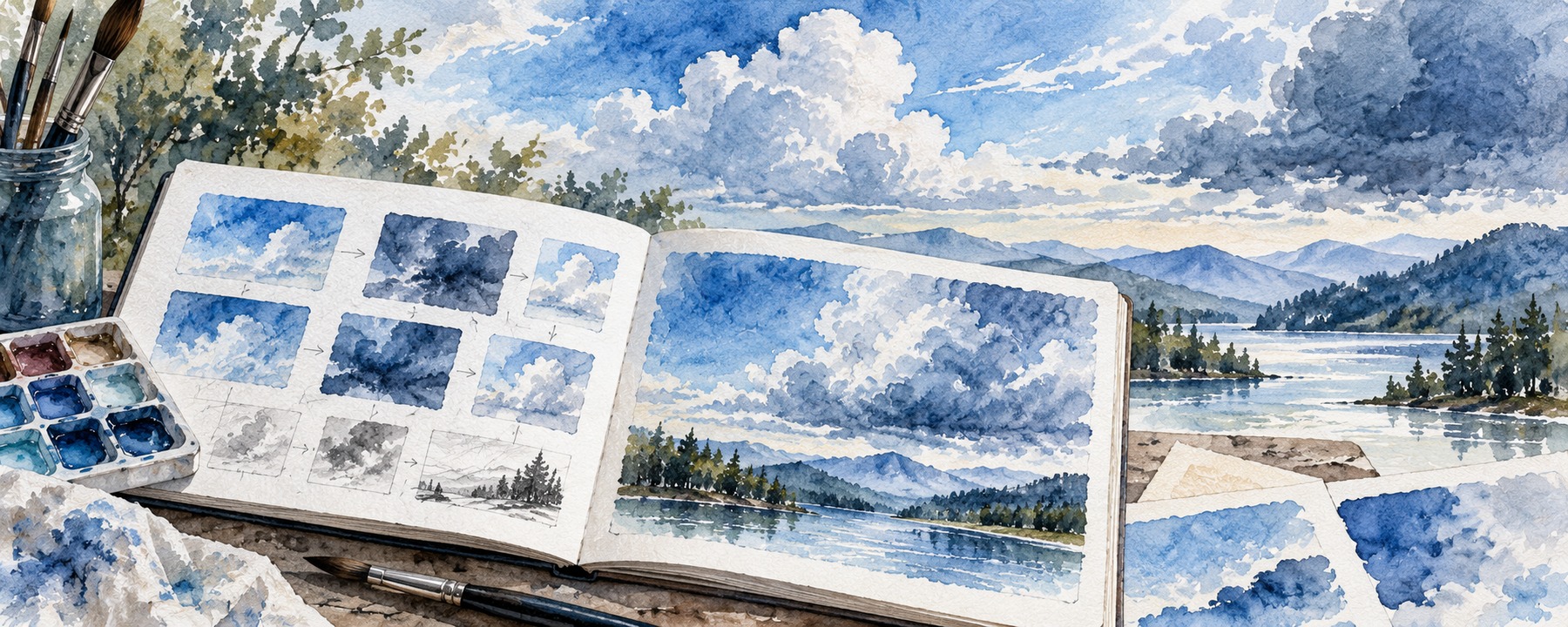
Wet-on-dry gives you placement. Wet-on-wet gives you diffusion. Use dry paper when you want the brush to define the boundary of the mark.
Wet-on-dry is not dry brush
In wet-on-dry, the paper is dry but the brush can still contain plenty of fluid paint. Dry brush is a different technique in which the brush itself contains relatively little moisture.
Why the edge stays sharper
Dry paper contains no surrounding film of moisture to carry the pigment outward. The water from your brush largely defines its own boundary, so the painted shape stays more confined.
This makes wet-on-dry useful for branches, windows, petals, cast shadows, foreground objects and other defined forms.
Wet-on-dry washes still require moisture control
A flat wash can begin on dry paper, but the wash itself creates a moving wet zone. If each new stroke overlaps the still-damp previous edge, the passage can dry evenly. Let that edge dry and visible bands may appear.
This is why wet-on-dry is not simply “the controlled technique.” Large passages still require speed, preparation and a suitably sized brush.
Layering and glazing
Wet paint applied over a completely dry earlier layer is also wet-on-dry. If the upper paint is transparent enough for the lower layer to remain visually involved, the process becomes glazing.
Earlier paint can still reactivate, especially if it is easy to lift. Brush pressure and the pigment's staining behaviour matter.
Controlled shape + soft interior
You can begin on dry paper to define a shape, then introduce additional color while the interior of that shape is still wet. The outer boundary stays controlled while the internal colors mingle.
This hybrid strategy is one of watercolor's most useful combinations.
Common problems
- Obvious stripes: the previous stroke dried before the next connected.
- Edges too sharp: switch to damp paper or soften deliberately with a controlled damp brush.
- Lower layer lifts: allow more drying time, use fewer passes or account for staining behaviour.
Wet-on-dry gives you placement. Wet-on-wet gives you diffusion. Watercolor becomes powerful when you can move between them deliberately.
Sources & verification
Core technical claims in this article were checked against the sources below. Picartica test protocols, editorial judgments and recommendations remain clearly separate from manufacturer claims.
- Canson — Basic concepts for painting with watercolorsManufacturer education
Wet-on-dry, wet-on-wet, wash, graduated wash and glazing definitions; practical wet/dry colour shift note. - Canson — Doing a flat washManufacturer education
Large flexible brush, continuous application, alternating strokes and overlapping the damp edge.
Verification status: core technical claims checked against the cited sources. Page structure, internal links and publication markup were re-audited for this release on 6 September 2026.