Fundamentals
How Watercolor Paint Works
What actually happens when watercolor meets water and paper? Understand pigment, binder, water, paper, drying, transparency, staining and granulation as one connected material system.
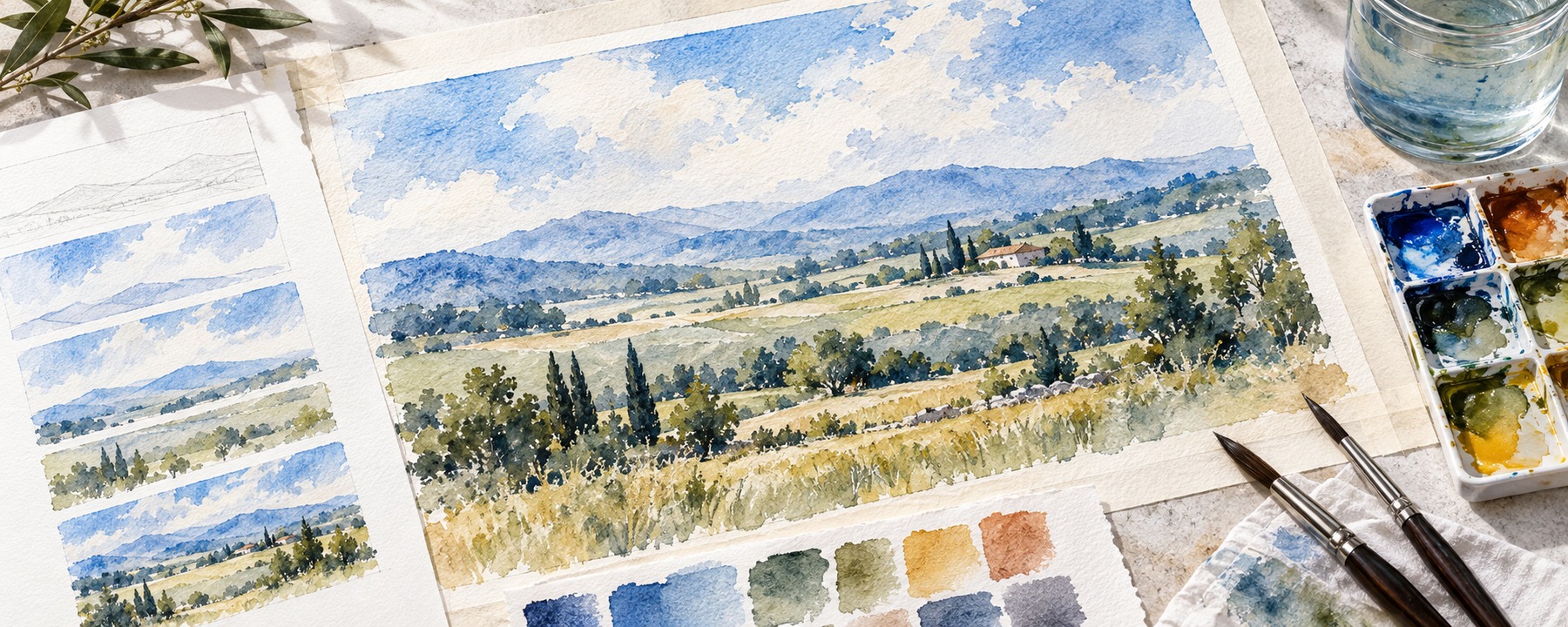
Pigment creates the color. Binder holds it. Water moves it. Paper receives it. Most watercolor behaviour becomes easier to understand once you can separate those four roles.
What is watercolor paint made of?
At its core, traditional watercolor is pigment dispersed in a water-soluble binder. In many artist watercolors that binder is gum arabic, although manufacturers may use additional ingredients to adjust flow, consistency, stability and other handling characteristics.
Pigment
Pigment is the colored solid material in the paint. It does not simply disappear into water like sugar dissolving in tea; extremely small pigment particles remain dispersed through the liquid and binder system. Their physical and optical characteristics contribute to properties artists experience as transparency, staining, granulation, tinting strength and lightfastness.
Binder
The binder helps hold pigment together in the pan or tube and helps the pigment remain attached to the painting surface after the water has left. Because watercolor's binder system remains water-responsive, dried paint can usually be reactivated.
Watercolor is not simply colored water. It is a movable pigment-and-binder system whose behaviour changes as water enters and leaves it.
Water is more than a thinner
Water changes both concentration and movement. Add more water and the color generally becomes paler because there is less pigment in a given area. At the same time, pigment has more freedom to travel across and through the wet surface.
The amount of water in three places matters at once: the palette mixture, the brush, and the paper. A wet brush placed on dry paper behaves differently from the same brush placed into a damp wash.
Picartica principle
When something unexpected happens, ask separately: How concentrated is the paint? How wet is the brush? How wet is the paper?
What happens when watercolor reaches the paper?
The paper becomes part of the system immediately. Moisture begins moving into and across the surface, and the paper's fibre composition, sizing, weight and texture influence where water travels and where pigment finally settles.
Watercolor paper is sized so it does not behave like untreated blotting paper. That controlled resistance can give you time to move a wash, soften an edge, lift pigment or add another color before the paint becomes fixed in its dry arrangement.
Why watercolor can appear luminous
Transparent watercolor often allows the light paper beneath the paint to remain visually active. A pale passage may contain very little pigment rather than added white paint. As layers become denser or more opaque, more of the underlying paper is visually obscured.
Why pigments behave differently
| Property | What you may notice |
|---|---|
| Transparency | How much the layer allows what lies beneath to remain visible. |
| Staining | How difficult the color is to lift once it has contacted the paper. |
| Granulation | Whether pigment settles with visible texture instead of an even wash. |
| Lightfastness | How resistant the color is to change under light exposure. |
| Pigment composition | Which Colour Index pigment or pigments make up the paint. |
Two paints can both be called blue yet behave very differently. One may dry almost perfectly smooth; another may settle into pronounced texture. One may lift readily; another may stain the sheet strongly. These are separate material properties, not one overall quality score.
Pigment codes
Artist paints commonly identify pigments with Colour Index names such as PB29 or PR101. These codes help you look beyond the marketing color name and compare what is actually entering a mixture.
What happens as watercolor dries?
As moisture leaves the painted area, pigment movement progressively slows. The working window changes continuously: an area that was fluid thirty seconds ago may now be damp enough to create a bloom if you introduce a wetter stroke.
The final dry appearance can also differ from the glossy wet wash. The practical rule is simple: make test swatches when an exact value or mixture matters, and compare dry paint with dry paint.
Try this: one pigment, four experiments
- Concentration: make swatches from strong paint to almost-clear wash.
- Surface moisture: use the same mixture on dry, damp and wet paper.
- Lifting: let a swatch dry, then try lifting a clean stripe.
- Surface: repeat the same wash on two different watercolor papers.
You are testing value, movement, staining and surface behaviour without changing everything at once.
Sources & verification
Core technical claims in this article were checked against the sources below. Picartica test protocols, editorial judgments and recommendations remain clearly separate from manufacturer claims.
- Schmincke — Watercolour FAQManufacturer
Watercolour composition; HORADAM tube/pan same pigmentation; travel vs large-format packaging considerations; wetting/fingerprint guidance. - Winsor & Newton — Gum Arabic mediumManufacturer
Gum arabic as a watercolour binder and its effects on flow/viscosity/transparency. - DANIEL SMITH — Watercolor for beginnersManufacturer education
Transparency, granulation, staining and lightfastness as distinct watercolour properties; transparency and glazing.
Verification status: core technical claims checked against the cited sources. Page structure, internal links and publication markup were re-audited for this release on 6 September 2026.